The industrial context
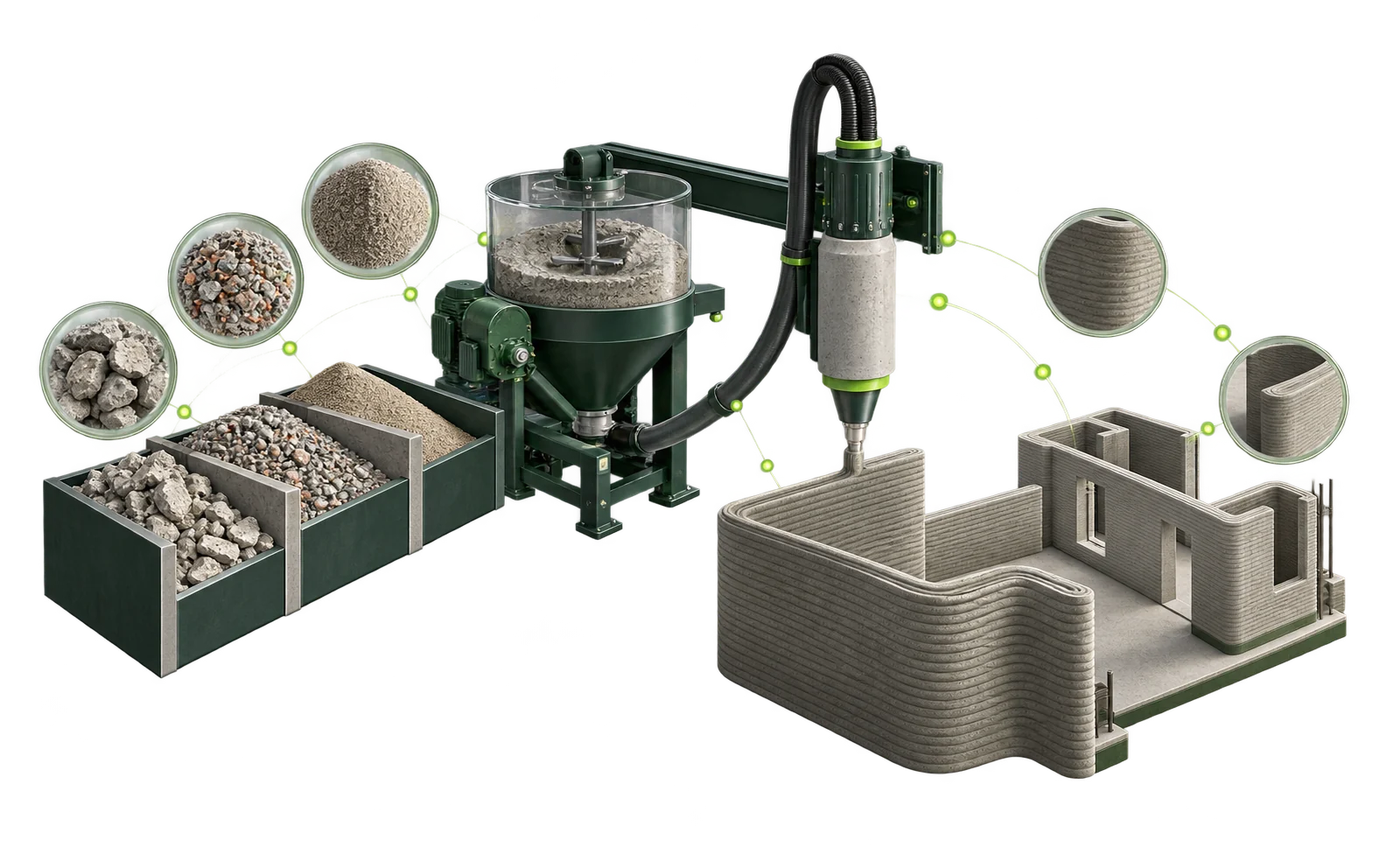
Additive manufacturing for construction promises fewer steps, less waste and greater geometric freedom. When the material includes recycled mineral aggregate, however, the project must connect two paths: creating value from a secondary material and making it compatible with controlled deposition. Feasibility therefore depends on the behaviour of the whole system rather than on one component.
The feasibility challenge
The study identified the variables that separate a promising idea from a verifiable research programme. Pumpability and extrusion need to be assessed together with the stability of the deposited material; print speed, layer thickness and geometry influence the final result. Inter-layer adhesion and process repeatability also become decisive criteria before moving towards an industrial scale.
What was studied
The work combined a review of the state of the art, technology risk, preliminary mix-design hypotheses, equipment alternatives and potential application scenarios. Non-structural elements, hybrid construction methods and prefabrication were considered as contexts for further investigation. The formulations identified are hypotheses for later trials: they organise experimentation rather than replace it.
A path for reducing uncertainty
Questions were arranged into a progressive sequence: characterise the material, verify its behaviour during transport and extrusion, observe deposition and then assess the resulting geometry. This approach helps isolate causes, compare alternatives and establish progression criteria before committing resources to more complex equipment and prototypes.
Project360 contribution
Project360 supported the initiative through cross-functional technology advice, project documentation, funding-application support and advisory coordination between the company and suppliers. Its contribution makes a programme spanning materials, automation, production and economic sustainability easier to govern while coordinating with the specialist expertise involved.
Transferable value
The case shows how to approach industrial projects in which technology and materials evolve together. Before discussing industrialisation, a roadmap needs to separate assumptions, tests and decisions. The same method is useful for circular-economy programmes, new materials and advanced production processes: it turns uncertainty into a manageable validation plan.