Why notarise a digital asset
Documents, designs and content can change, be duplicated or circulate outside the system that created them. Notarisation establishes verifiable time-based evidence of a file’s existence and integrity. The PoC studies this principle without turning the blockchain into a content repository.
Evidence separated from preservation
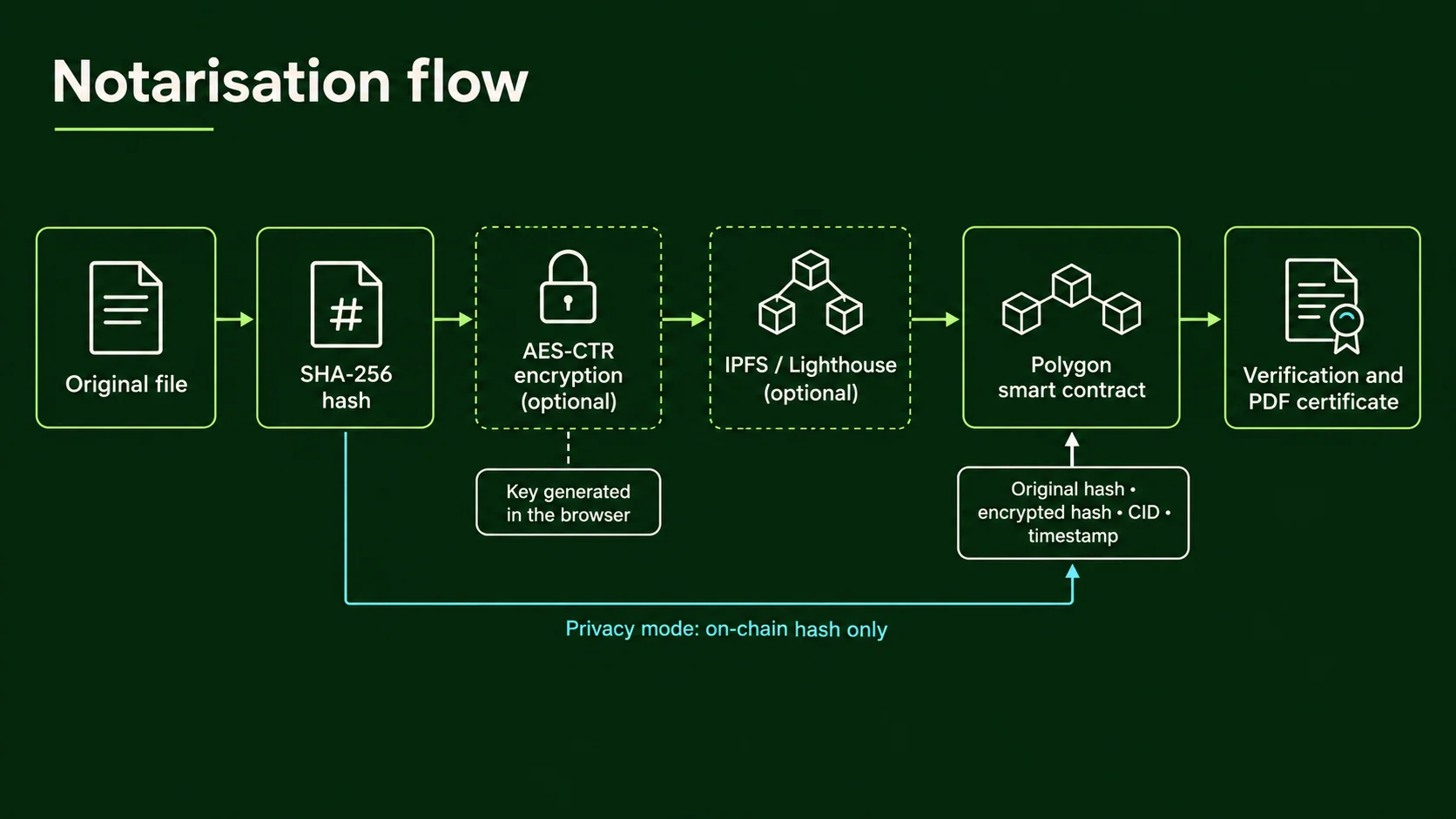
The smart contract records the information needed for verification, while IPFS is involved only when a distributed copy is useful. This separation avoids confusing proof with storage and supports different processes for intellectual property, project documents, traceability or inter-organisational exchange.
Cryptography in the browser
The file can be encrypted before leaving the device. The PoC uses AES-CTR and records both the original and encrypted hashes on-chain, together with the CID and timestamp. Key custody remains a process concern rather than an implementation detail hidden by the interface.
Verification and certification
Verification can start from an identifier, hash, file or CID. The system compares fingerprints, retrieves the registered data and, when the encrypted content and key are available, supports decryption. A PDF certificate summarises the evidence in a form that remains readable outside the application.
Experimentation as Project360 capability
Project360 connected browser-side cryptographic processing, optional encryption, IPFS storage, Polygon smart-contract calls, record search, verification and certificate generation in one prototype. The work demonstrates applied Web3 understanding: technologies, dependencies, interfaces and responsibilities that must operate within one process.
From PoC to real processes
The same pattern can support intellectual-property protection, document traceability, approval steps, proof of delivery and verifiable exchange between organisations. Project360 can determine when DLT adds value, design the process, integrate existing systems and build a verifiable MVP. Production evolution then covers identity, roles, custody policies, error handling, monitoring and operational continuity.