A lab for understanding IoT in practice
Many IoT projects remain abstract while hardware, networking and software are studied separately. Smart360 makes the complete chain visible: a sensor produces data, a device acquires it, the network carries it, the platform interprets it and a rule can turn it into an action. The project combined a building automation prototype, a full-stack platform and an education environment built around real components.
The experiment went beyond representing an idea. Physical prototypes, portable kits and software services made inputs, outputs, control logic and interfaces observable. Technology became something that could be assembled, programmed, measured and discussed.
Smart360 Demo: the complete system at prototype scale
The Smart360 demo applied IoT to the management of a connected environment. Raspberry Pi and Linux interacted with analogue and digital sensors, actuators and a custom prototype board. The system could read environmental conditions, apply rules, control devices and expose events through remote interfaces.
The project documentation also records experiments with offline voice interaction, computer vision on video streams and distributed data logging. These elements are presented as parts of an R&D path rather than standalone products: they demonstrate the ability to integrate heterogeneous components, check end-to-end behaviour and distinguish mature modules from those requiring further validation.
IoTLAB: from demo to a modular environment
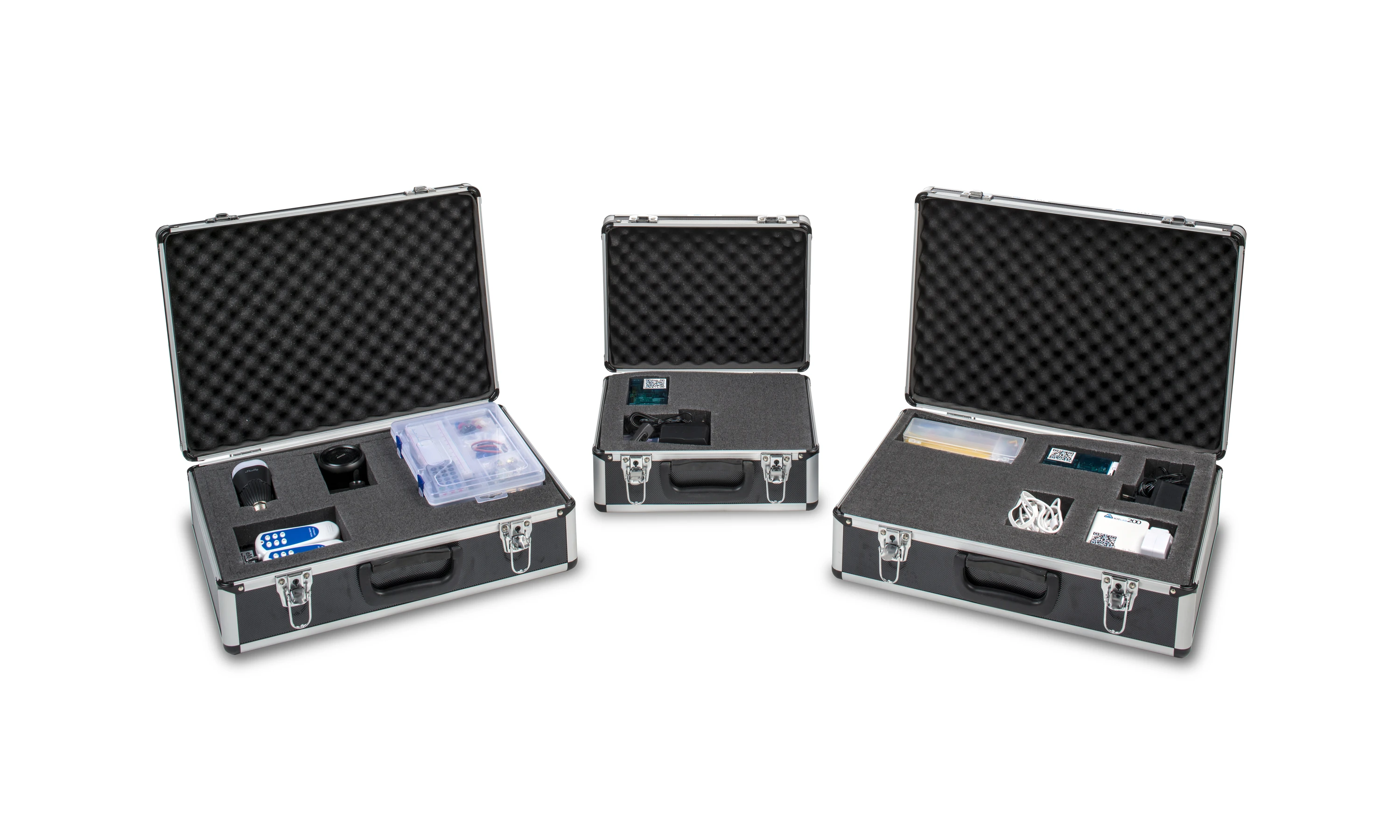
Project360 translated the same logic into portable IoTLAB cases. Each station combined a Raspberry Pi, breadboard, sensors, actuators and electronic components. The platform ran locally on Linux and provided tools for lessons and projects, Git versioning, a web development environment, shared workspaces and a headless content manager accessible through APIs.
The learning path connected Python, JavaScript and C with GPIO control, MQTT messaging and JSON data structures. A circuit no longer stood alone: it became one node in a system where electronics, software, networking and interfaces had to work together.
An experiment built with the school
The collaboration with ITI Buonarroti-Pozzo in Trento brought this architecture into the school laboratory. Students could work with real components, follow the path from signal to interface and build group projects inside a controlled environment.
The class was organised into seven teams, each responsible for a module connected to the others through MQTT. Rules, inputs and outputs, thermostat functions, temperature and humidity sensing, climate control and simulated event detection contributed to one distributed class project. The cases made the workstations repeatable, while the lab network gave teachers and teams distinct ways to follow content, code and integrations.
Project360 contribution
Project360 delivered the technology concept, full-stack platform development, hardware/software integration, prototypes and demonstration kits. It also prepared the demo and worked with the institute to adapt the technical environment to laboratory use. Teaching remained a shared effort with the school; Project360’s contribution focused on architecture, tools and the transition from technology concept to test bench.
Prototype before scaling
The project shows how a well-designed demo can reduce the risk of broader initiatives. Before changing a real building or process, sensors, protocols, integrations, interfaces and automation logic can be checked in a repeatable environment. The same method applies to corporate proof of concepts, innovation labs and technical training: separate the modules, make each transition observable and collect evidence before scaling.
Funding and project development
Smart360’s initial phase received a €20,000 non-repayable grant through the Lazio Region / Lazio Innova Pre-Seed programme. This supported the start of Project360’s technology initiative; the subsequent educational collaboration in Trento brought the platform, prototypes and kits into a further application context.