FUNCTIONAL MODEL
Keep the process configurable.
Separating customer records, templates and orders allows questions to evolve while keeping the workflow coherent. Answers control the visibility of later steps, keeping collection relevant to the job.
CASE STUDY / PROPOSAL
Digitising a made-to-measure order means clarifying the handover between field measurement and production planning.
 Organisation / project
THE PROJECT, EXPLAINED
FUNCTIONAL MODEL
Separating customer records, templates and orders allows questions to evolve while keeping the workflow coherent. Answers control the visibility of later steps, keeping collection relevant to the job.
BACK OFFICE
The form editor brings product knowledge into the collection tool. Questions, options and conditions become part of a shared model between the business and its field network.
A made-to-measure tarpaulin starts with information collected away from the office: trailer type, cover geometry, dimensions and construction details. When these details travel on paper forms, the quality of the order depends on complete measurements and the effort required to interpret them. SmartOrder360 addresses this transition for Teloni Tosetto, connecting its distributor network to structured production data collection.
The proposal defines an initial digital system with straightforward operations and an extensible architecture. Its purpose is to make the order form understandable for the person taking measurements and usable for those turning the data into a manufacturing job.
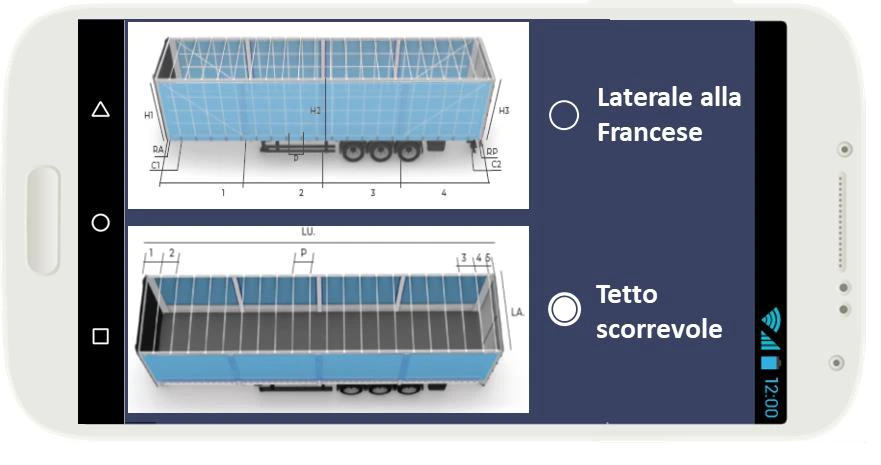
The proposed application guides operators through a wizard: the selected product type determines the questions that follow. Pictures, dimensioned drawings and multimedia instructions help identify the component and the measurement required. Numeric fields with permitted ranges and a dedicated keypad make smartphone data entry easier to control.
Forms can be saved partway through and resumed before submission. Sections and progress indicators provide orientation within complex orders, avoiding questions that do not apply to the selected configuration.
The back office brings together customer records, orders and form composition. The business can organise questions, answers, categories and visibility rules, assigning different templates to customers or product types. This makes the process configurable rather than a collection of screens to rewrite whenever requirements change.
Order management includes search, consultation and export in CSV, XML and PDF. A summary containing an identifier, date and collected answers supports the handover to office and production teams, alongside notifications defined by the workflow.
The proposed architecture connects a mobile client for field operators, a web back office and a cloud/VPS backend with a dedicated database. Customer records, templates and orders are separate but related entities: changes to the collection model must remain manageable without losing the relationship between customer and request.
The analysis compares a PWA with a hybrid application according to devices, user experience and required integrations. Technology choices follow the process and adoption constraints before languages or frameworks are fixed.
Project360 translated Teloni Tosetto’s requirements into a technical and economic proposal, outlining requirements, workflows, logical structure, mobile interactions and back-office functions. The work connected process analysis, functional design and activity planning, identifying an initial scope and extensions to assess separately.
This expertise is relevant to manufacturers collecting field information for customised production: understand the required data, design a usable interface and organise its handover to business systems, bringing together the development resources suited to the project.
The potential extensions include offline collection, photographic attachments, staged approvals and the completion of custom document templates. The complementary SmartMeasure360 initiative also raises the possibility of integrating measurement devices and further services through APIs. These options support a progressive roadmap in which the operating value of each extension is assessed first.
FROM PROJECT TO INDUSTRY
Explore the complete portfolioWe start from context, dependencies and the decisions needed to build a credible path.
Let’s talk